Invasion of the Brand Snatchers: Brand Differentiation in the Age of AI
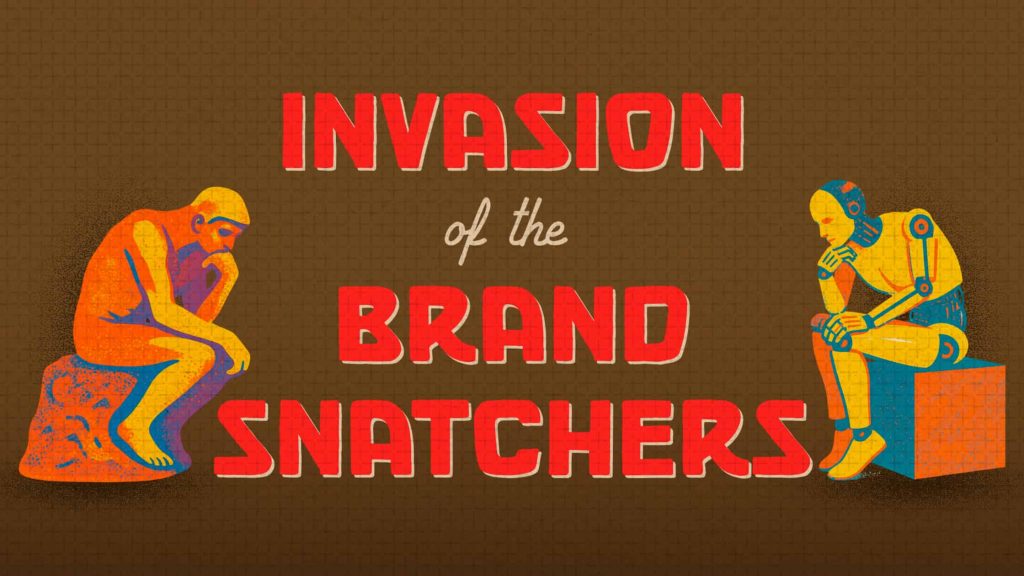
They have infiltrated our websites! They have seized control of our inboxes! They have learned our brand guidelines and are using them AGAINST US!
The AI content invasion is well underway, and for professional services firms whose reputations depend on expertise and trust, the stakes are particularly high. When every organization sounds equally knowledgeable, how do you give people a reason to choose yours? Let’s investigate what makes a brand worth remembering, and why the answer might be more human than we think.
THE GREAT BRAND BLANDENING
For thousands of years, people labored over the things they wrote. There was something so human about the whole thing: the Sisyphean task of finding the right words, agonizing over where a comma goes, writing each letter by hand until fingers were cramped and numb with effort.
Then, somewhere deep in the fluorescent bowels of Silicon Valley, a group of engineers looked at millennia of human creativity and thought: bro, what if we could automate that? Thus began the Great Brand Blandening. The world is now awash with perfectly pleasant prose, all delivered with the same vaguely enthusiastic tone. Everyone sounds articulate, everyone sounds excruciatingly agreeable, and absolutely no one sounds interesting.
What makes content sound like AI?
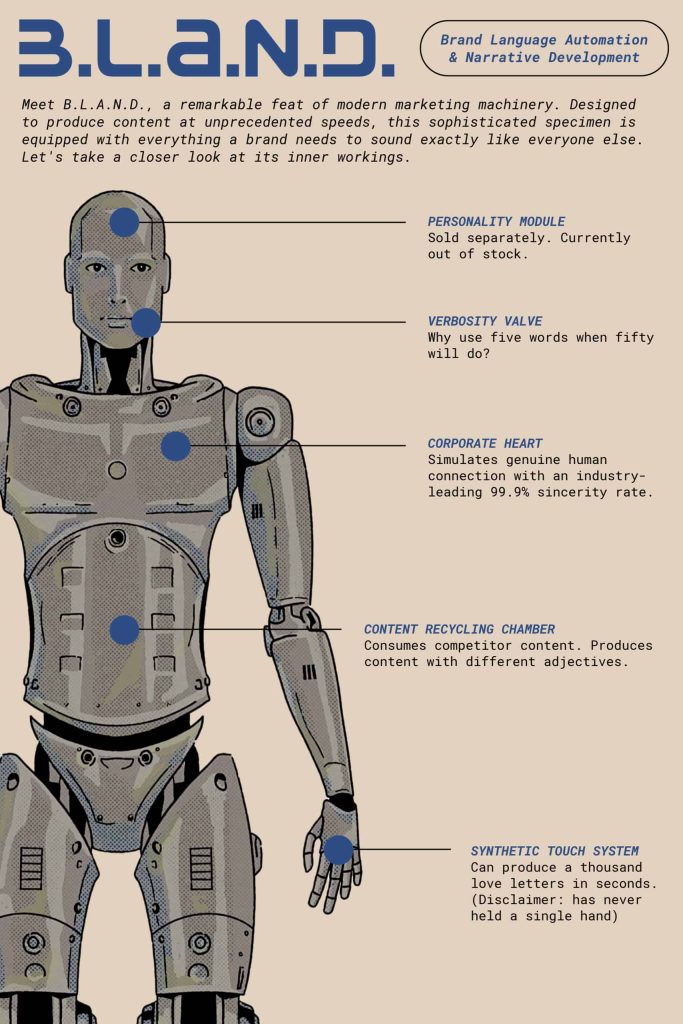
There’s a certain je ne sais quoi about AI writing that reeks of desperation and warm plastic. People are pretty good at determining if visuals are generated, at least in AI’s current form. By now, we’ve all come across a ChatGPT-generated restaurant menu featuring food that looks like an unholy union between amorphous goo and termite-infested wood. But when it comes to the written word, AI’s fingerprints have proven a little harder to spot.
Here are a few telltale signs worth keeping an eye out for:
3 SIGNS OF AI WRITING
- It’s not _____. It’s ______. One thing about AI: it LOVES to tell you what something is not, setting up a seemingly profound “gotcha!” moment whenever it gets the chance. This TED Talk-ification of the English language is everywhere, once your eyes are opened to it. Sorry about that.
- Em dashes: Look how they massacred my boy! Of course the robots get their grubby little mechanical mitts all over the most beautiful, versatile punctuation mark there has ever been, and ever will be. There are several hypotheses for why AI does this, but all you have to know is that it’s happening, and it’s awful.
- Smartish-sounding words: A 2025 study found a significant shift in the frequency of certain words following ChatGPT’s release. There’s a bit of a “robot chicken or egg” situation going on with this one: is AI picking up these words from us, or are we picking them up from AI? Regardless, let’s delve into these crucial words and explore their significant potential to leverage important insights, foster critical conversations, and unlock the full potential of language itself!
A necessary disclaimer that the signs of AI writing are constantly changing, evolving just as quickly as our ability to recognize them. Arena AI analyzed Claude Opus 5 vs 5.5, and found that it’s already using 95% fewer em dashes. At the same time, its answers are getting 6% wordier, so I suppose brevity is the price of saving the beloved em dash from the fires of scrutiny.
Can buyers tell when content is written by AI?
The human race has gotten really good at pointing fingers at suspiciously robotic content. At the same time, our ability to correctly identify the mechanical imposters among us isn’t nearly as impressive as we’d all like to believe.
In a 2026 study, Ipsos and Syracuse University put 20 advertisements in front of 3,000 American consumers. Half were created by humans, while the other half were generated entirely by AI. The result? Only 25% of viewers who saw an AI-generated ad were even somewhat confident that a machine had made it. So much for our finely tuned human instincts.
But wait, don’t go to the next section yet! Even when viewers couldn’t reliably identify the robots’ handiwork, the human-created ads still performed better. On average, they scored 14% higher on Ipsos’s short-term advertising effectiveness measure and 17% higher on its long-term brand impact measure. Participants also found the human-made ads more entertaining, imaginative, and worth talking about. Imagine that!
The data shows that we don’t always recognize human creativity when we see it, but we can sure feel the difference when it’s missing.
Does AI-generated content hurt brand trust?
You may be thinking: okay, if we can’t reliably distinguish between human and AI-generated writing, then does it really matter who’s behind the words? And— my writer ego aside— it’s a fair point, given the data we just talked about.
Ultimately, it depends on what we’re asking those words to do. A robot can write a perfectly fine paragraph about the importance of financial planning, making compelling points and putting them into a neat little structure that makes our skim-happy brains satisfied.
But if you’re trusting someone with your retirement savings, you probably want to know there’s another human being on the other end of that advice, right? Preferably one with a vested interest in your financial well-being. A robot has never lost sleep over a mortgage payment or wondered whether they were putting enough money in their 401(k). It has no skin in the game! Or any skin at all, in fact.
For brands, trust has always depended on more than just sounding knowledgeable. When content starts to sound impersonal or interchangeable, audiences have a harder time recognizing the expertise that supposedly sets one organization apart from another. And if everyone sounds equally qualified, why should anyone choose you?
Why does authenticity matter more in the age of AI?
We’re living in an age of unprecedented convenience. A few taps on my phone and I could have a bounce house and a 40-pound wheel of parmesan cheese on my doorstep in a matter of hours! But access and fulfillment are two very different things. Somewhere in our pursuit of convenience, we’ve begun to feel the absence of some very human qualities: passion, connection, craft, and truth (among others).
Cultural strategist Jasmine Bina calls these gnawing spaces between what modern life offers and what we’re still hungry for “cultural vacuums.” In her keynote at Amazon’s global design summit, she identifies several of these vacuums, including the ones surrounding craft and work, trust and vulnerability, and collective time.
We want to know that someone cared enough to make the things we consume. We want to believe the people we’re listening to actually mean what they’re saying. And despite having more ways to communicate than ever before, we’re still desperately searching for a genuine connection with someone on the other end of the line.
AI has arrived at a curious cultural moment, when the things we’re learning to automate are some of the very things we’re longing to experience. Consequently, brands now sit at a crossroads. Down one path: a glorious future of frictionless content creation, where every brand sounds utterly indistinguishable from the next. Down the other? An opportunity to put all that technological wizardry in service of an actual, honest-to-God point of view. After all, there’s a world of difference between knowing how to say something and having something worth saying.
HAVING A VOICE VS. HAVING A POINT OF VIEW
What is a brand point of view?
In your company’s cavernous shared drive, you might find a brand guidelines document explaining exactly how your organization should sound. You’re warm but professional. You’re bold yet approachable. You’re playful, but never irreverent. And all of these traits come together to form the great and powerful brand voice.
But what does it actually have to say?
This is the main difference between brand voice and brand point of view. Your brand voice determines how you communicate: your tone, personality, vocabulary, and style. Your brand point of view, on the other hand, is what you actually believe. It’s the perspective your organization brings to its industry, shaped by the experiences you’ve had, the problems you’ve solved, and those neat little things you’ve learned along the way.
How do you differentiate a brand when everyone uses AI?
For most of marketing history, producing a steady stream of polished, perfectly adequate content required two things: money, and a copywriter hopped up on caffeine and dreams of finally publishing their book of short stories.
Now, all you need (in theory) is a login to your LLM of choice. But this raises the question: when everyone has access to the same tools, how do you stand out from the crowd?
Fortunately, your organization has something no language model can manufacture from scratch. AKA, the collective experience of the actual people who work there. The conversations, the unexpected questions, the stories that come tumbling out when someone starts talking about what they love. Somewhere in all that lived experience are the ideas that make your organization different from the one down the street.
Professional ≠ Predictable
How can professional services firms stand out from competitors?
The unwritten rule of professional services marketing seems to be that the more important your work is, the less interesting you’re allowed to sound. Law firms, consultancies, engineering companies and other professional services organizations have spent decades perfecting the art of saying impressive things in profoundly unremarkable ways.
And to be fair, that instinct makes perfect sense. When people are trusting you with their businesses, livelihoods, and futures, you probably do want to project a certain degree of professionalism. And yet, somewhere along the way, we’ve confused sounding professional with sounding exactly like everyone else.
Consider two law firms, one of which may have been created by AI in the past ten minutes, and the other the product of actual human brains right here at The Abbi Agency:
| CHATGPT AT LAW | DE CASTROVERDE LAW GROUP | |
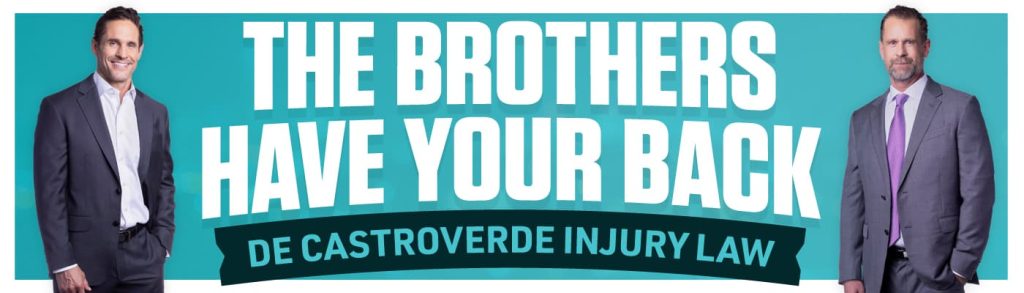
| Tagline | “Your Trusted Partners in Legal Excellence.” | “The Brothers Have Your Back.” |
| Personality | Professional, approachable, compassionate, results-driven. | Protective, personal, confident, family-oriented. |
| Core Message | We deliver exceptional legal representation tailored to your unique needs. | When you’re going through something difficult, the brothers are in your corner. |
| What Makes it Different? | Nothing! These claims could belong to literally any law firm in the whole world. | A family history and two identifiable leaders give the promise a recognizable identity. |

On one side of the ring, we have ChatGPT at Law™, a completely fictional firm promising to be “Your Trusted Partners in Legal Excellence.” Its attorneys appear to be very professional, although we’re still investigating whether all of them possess the correct number of fingers.
On the other, we have De Castroverde Law Group, a family-run Nevada law firm whose brand The Abbi Agency helped develop around a much more memorable promise: “The Brothers Have Your Back.”
The difference between these two goes much deeper than a clever tagline. De Castroverde has a real family history, two brothers leading the firm, and a brand built around the idea of having someone in your corner when life gets difficult. Just like that, we’re talking about actual people with an actual story.
Both firms can promise excellent legal representation, but only one gives a compelling reason to remember who’s making that promise.
And that’s the opportunity for professional services firms of every stripe. Your expertise deserves to be taken seriously, but that doesn’t mean your marketing has to take itself quite so seriously. There’s room for personality, conviction, and a little creative risk, even when the stakes are high.
How do law, accounting, or consulting firms build thought leadership?
“Thought leadership” is a funny little term for something that spends so much time repeating what everyone else is saying. Somewhere on LinkedIn, a company just published their 400th post about navigating this ever-changing business landscape. And we wish them well!
And just to be clear, there’s nothing wrong with educational content. People need answers to their questions, and professional services firms are uniquely qualified to provide them. But there’s a difference between explaining what you know and showing people how you think.
Consider an employment law firm publishing an article about recent changes to workplace regulations. Useful? Absolutely. But what if the firm’s attorneys have noticed that employers consistently misunderstand one particular requirement? What if they’ve seen the same costly mistake play out across dozens of cases? Suddenly, there’s an opportunity to offer something more valuable than a summary of the rules: an informed perspective shaped by firsthand experience.
Finding those perspectives often requires a little digging. Ask your subject matter experts what they wish their clients understood, what conventional wisdom they disagree with, or what they’ve changed their minds about after years in the field. These are the insights that give thought leadership real substance. Sure, an AI tool can summarize regulations and explain business concepts, but it can’t reach into the years of experience your team has addressing these issues in the real world.
Remember your clients can go anywhere on the internet for information. Give them a reason to come to you.
Practical Ways to Use AI
How do you keep a human brand voice while using AI tools?
After spending the better part of this article publicly criticizing our robot overlords, I would like to make amends. And a confession: I use AI. Quite a bit, actually. And when used thoughtfully, it’s a genuinely remarkable tool. The trick is figuring out which parts of the creative process benefit from automation and which parts deserve the attention of a living, breathing human being.
Your brand voice guidelines are a good place to begin. Give your AI tools examples of your organization’s actual writing, explain the personality behind it, and establish some ground rules. If your brand has never once described itself as “passionate about delivering innovative solutions,” now is a wonderful time to make that explicitly forbidden, for the rest of time.
However, even the most detailed guide to brand voice can’t replace the thinking that makes your work worth reading in the first place.
As writer and creative strategist Thomas Cox argues in his article, Rage Against the Machine: 4 Ways Writers Can Fight Back and Use AI Responsibly, writers need to resist the temptation to skip the difficult, messy process of developing their own ideas.
Here are a few ways we can use AI, while still keeping the human elements intact:
- Do your own thinking first. Before opening your favorite chatbot, spend some time figuring out what you actually want to say. What do you believe about the subject? What have you experienced that informs that belief? What might your audience find surprising? Give yourself permission to wrestle with an idea before asking a machine to help you articulate it.
- Start with something real. Give AI original material to work with, whether that’s an interview with a subject matter expert, notes from a client conversation, or an observation your team has made through years of experience. The more specific the source material, the less room there is for generic filler and robotic fluff.
- Make AI challenge you. Instead of asking it to write something brilliant right off the bat, ask it to poke holes in your argument. Tell it to identify assumptions, question your conclusions or interview you about an idea you’re developing. As Cox suggests, a useful AI collaborator should help sharpen your thinking rather than simply congratulate you for having thoughts.
- Let it handle the less glamorous work. Grammar checks, proofreading and identifying structural inconsistencies are all useful applications. Just be explicit about preserving your original voice and meaning! Sometimes AI wants to dim your delightfully human shine, and we just can’t let that happen.
- Keep a human in the editor’s chair. Read every output critically. VERY critically, in fact. Does it sound like your organization? Does it reflect what you actually believe? Is every claim accurate? And perhaps most importantly, would anyone care enough to keep reading? Don’t be afraid to delete an entire paragraph just because a robot worked very hard for five seconds on it.
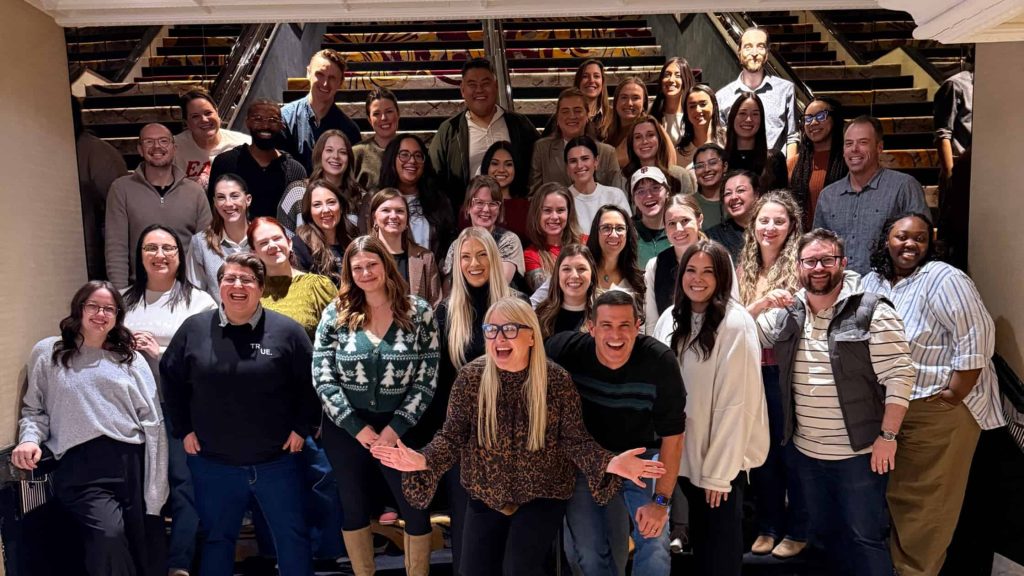
Send in the Humans
The future of marketing will almost certainly involve artificial intelligence, but the brands worth remembering will still be shaped by the wonderfully complicated people behind them.
So, from one human to another: don’t let the robots steal your brand’s personality.
And if you need help getting it back, we know some people.